Materials and Structures
Materials decide how a wine bag feels in a hand, how it prints, and whether it survives a courier van. Here is what we use, why we set minimums, and where each material is the wrong pick.
The board standard
We use greyboard at 1200 g minimum, and recommend 1400 g for spirits. Lighter board feels flimsy and the corners dent. Heavier board is harder to crease cleanly, so you get cracking instead of a fold. We do not use recycled greyboard because its density varies, and that shows up as a wavy side panel. We also reject high-moisture paper. It warps after printing and the corners lift. Facing paper starts at 157 g specialty or coated stock. Below that, ink soaks through and the surface looks cheap.
Six common materials
Greyboard with specialty paper
The standard build for a rigid wine bag or box. The greyboard gives the structure, the specialty paper gives the surface. It takes foil and embossing well, but a thin facing paper will show the greyboard through at the corners.
Kraft paper
Used for budget wine bags and shipping boxes. It prints in one or two colors best, and it hides scuffs. It does not hold fine detail or metallic inks, so it is the wrong pick for a luxury gift.
White card
A coated stock for crisp full-color printing. It is the default when a buyer wants a photo or a detailed illustration on the bag. It shows fingerprints more than kraft, so a matte lamination is usually added.
Gold or silver cardboard
A metallic facing paper for premium wine bags. It reflects light and makes a shelf display pop. It is hard to print on, so we usually foil stamp or deboss instead. It scratches if not laminated.
Flocked paper
A velvet-like surface for gift boxes and inserts. It feels expensive and holds a bottle without sliding. It does not take ink well, so any logo is usually foil stamped or printed on a separate label.
Leather-textured paper
A paper that looks and feels like leather at a fraction of the cost. It is used for wine bags and box wraps. It wears well on a shelf, but it can crack at the crease if the grain direction is wrong.
Six box structures
Rigid lid-and-base
A two-piece box with a separate lid. It is the classic for a single bottle gift. The lid needs a facing paper that can handle the wrap around the edges without tearing.
Magnetic closure
A rigid box with a flap that snaps shut. It feels more premium than a tuck flap. The magnet position is controlled to plus or minus 1 mm, or the flap will not sit flush.
Drawer
A box with a sliding tray. It works well for a bottle plus a glass or a corkscrew. The drawer needs a tight tolerance or it will rattle in the outer sleeve.
Foldable
A flat-packed box that the buyer erects. It saves shipping cost. The creases must not crack, and the corners should hit 90 degrees when erected, or the box looks warped.
Double-door
A box with two front panels that open like doors. It is a showpiece for a high-end bottle. The hinges are just creased paper, so the facing paper has to be flexible enough to open hundreds of times.
With handles
A wine bag with a rope, ribbon, or die-cut handle. The handle needs a reinforced attachment point. A handle that rips out on the first carry is a return waiting to happen.
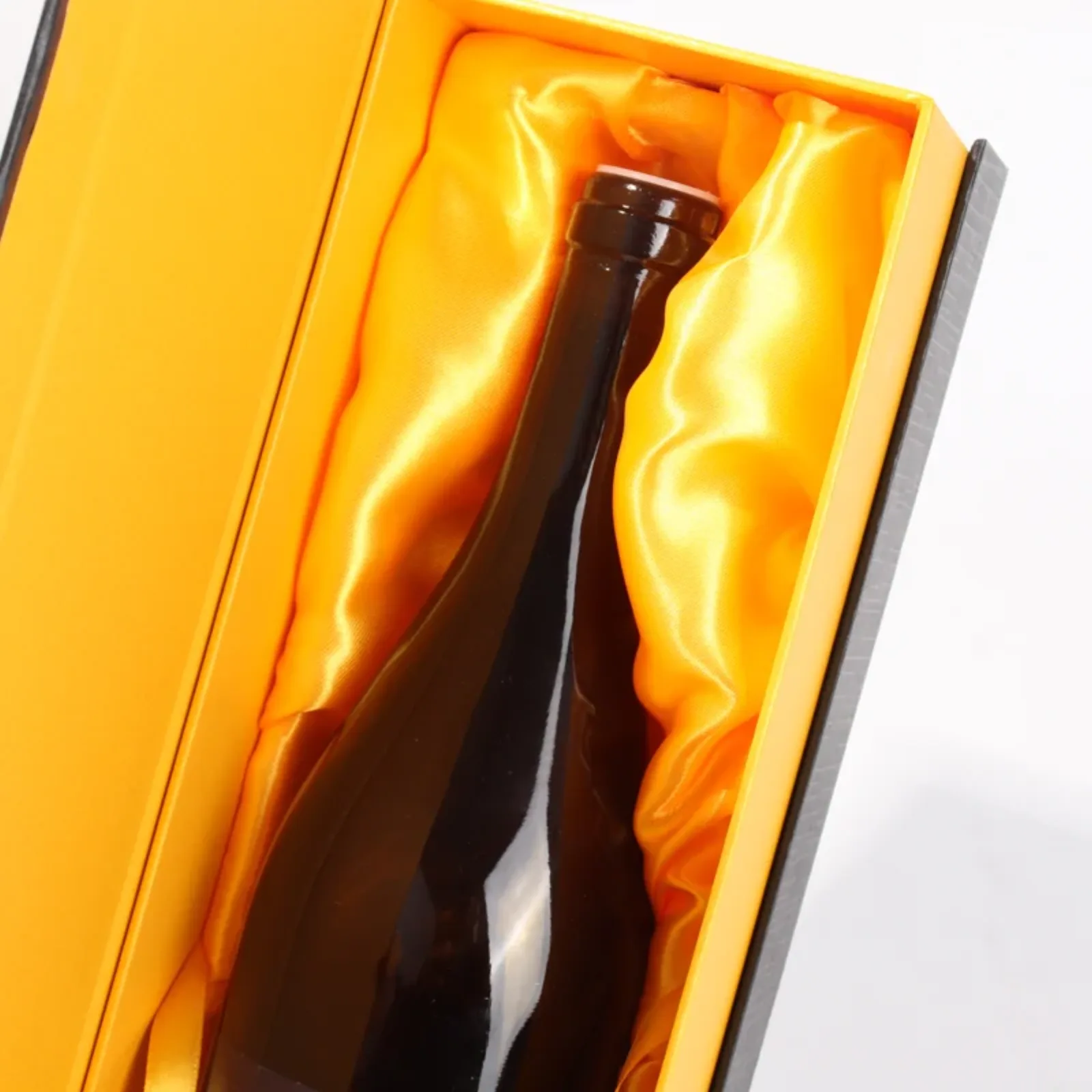
Four insert types
Velvet tray
A flocked tray that holds the bottle at the base and neck. It is the softest option and looks high-end. It is not for heavy bottles, because the flocking can compress over time.
EVA foam
A dense foam insert that is cut to the bottle shape. It gives the best shock absorption. It is the right pick for shipping a bottle, but it looks industrial, so it is usually covered with a paper wrap.
Blister
A clear plastic tray that shows the bottle. It is lightweight and cheap. It scratches easily, and it can look cheap if the plastic is too thin, so we specify a minimum thickness.
Paper mould
A moulded pulp insert. It is the most sustainable option and it is compostable. It is not as precise as foam, so the bottle can shift if the mould is not made from an exact bottle sample.
How to combine them
Start with the bottle. A heavy champagne bottle needs 1400 g greyboard and an EVA foam insert. A standard 750 ml wine bottle is fine with 1200 g board and a velvet tray. If the bag will be shipped in a courier van, not just handed over a counter, go up a weight and add a paper mould or foam insert. The insert must hold the bottle at four points: base, body, shoulder, neck. No unsupported neck. We shake the box for ten seconds, tilt it 45 degrees, and invert it. If the bottle moves, the insert is wrong.
Then pick the facing paper. For a retail shelf, white card with a matte lamination prints a label or photo well and hides fingerprints. For a corporate gift, a leather-textured paper or flocked paper feels more expensive. For a budget promotional bag, kraft paper with a one-color print is enough. If you want foil, use a smooth specialty paper, not a textured one. Foil on a textured paper looks broken. And if the bag is black, deep blue, or burgundy, expect more color variation between runs. Those are the hardest to hold.
Buyer questions
What is the minimum facing paper weight you will use?
157 g specialty or coated stock. Below that, the ink soaks through and the surface looks cheap. We also reject high-moisture paper. It warps after printing and the corners lift. For a rigid box, the facing paper has to wrap around the edges without tearing, so we test a crease sample before we commit.
Can I use a textured paper for foil stamping?
It is not recommended. Foil on a textured paper looks broken because the foil only hits the high points. Use a smooth specialty paper for foil. If you want a textured feel and foil, we can deboss the foil area first or use a separate label panel.
Which insert is best for shipping a bottle?
EVA foam is the best shock absorber. It is cut to the bottle shape and holds it at four points. A paper mould is more sustainable but less precise, so it works for a standard bottle shape. A velvet tray is for gifting, not shipping. If the bottle will be couriered, use foam or a paper mould, and we will run the drop and vibration checks.
Not sure which material fits?
Send the bottle and the market it ships to. We propose board, facing paper and insert together.
- Email[email protected]