23 September 2026
Custom Reusable Wine Bags: A Bulk Buyer's Guide
Custom reusable wine bags are specified by matching material to reuse cycles, not by picking a colour. A kraft bag that looks right in a photo can crease and soften after a few handoffs. Felt, canvas and leather hold up longer. Here is how we choose between them, and where our range stops.
Match the material to reuse cycles
Ask your buyer one question before anything else: how many times will this bag be carried? A promotional bag handed out once at an event and a retail bag that goes home with a 750 ml bottle and comes back to the shop for a refill are different products. Kraft paper is light, prints beautifully and costs the least, but it creases and softens with handling. Felt and canvas are thicker and hold their shape far better over repeated use. Leather and faux leather sit at the top for durability and premium feel.
That ranking is not a marketing claim, it's what we see on the bench. Paper fibers break down at the fold lines first, then the handle patch. Felt resists that because the material has bulk. Canvas resists it because the weave carries load. Leather resists it because the grain and the stitching take the stress. Pick the material that survives the number of trips your buyer actually expects, not the one that photographs best.
Paper, felt, canvas and leather compared
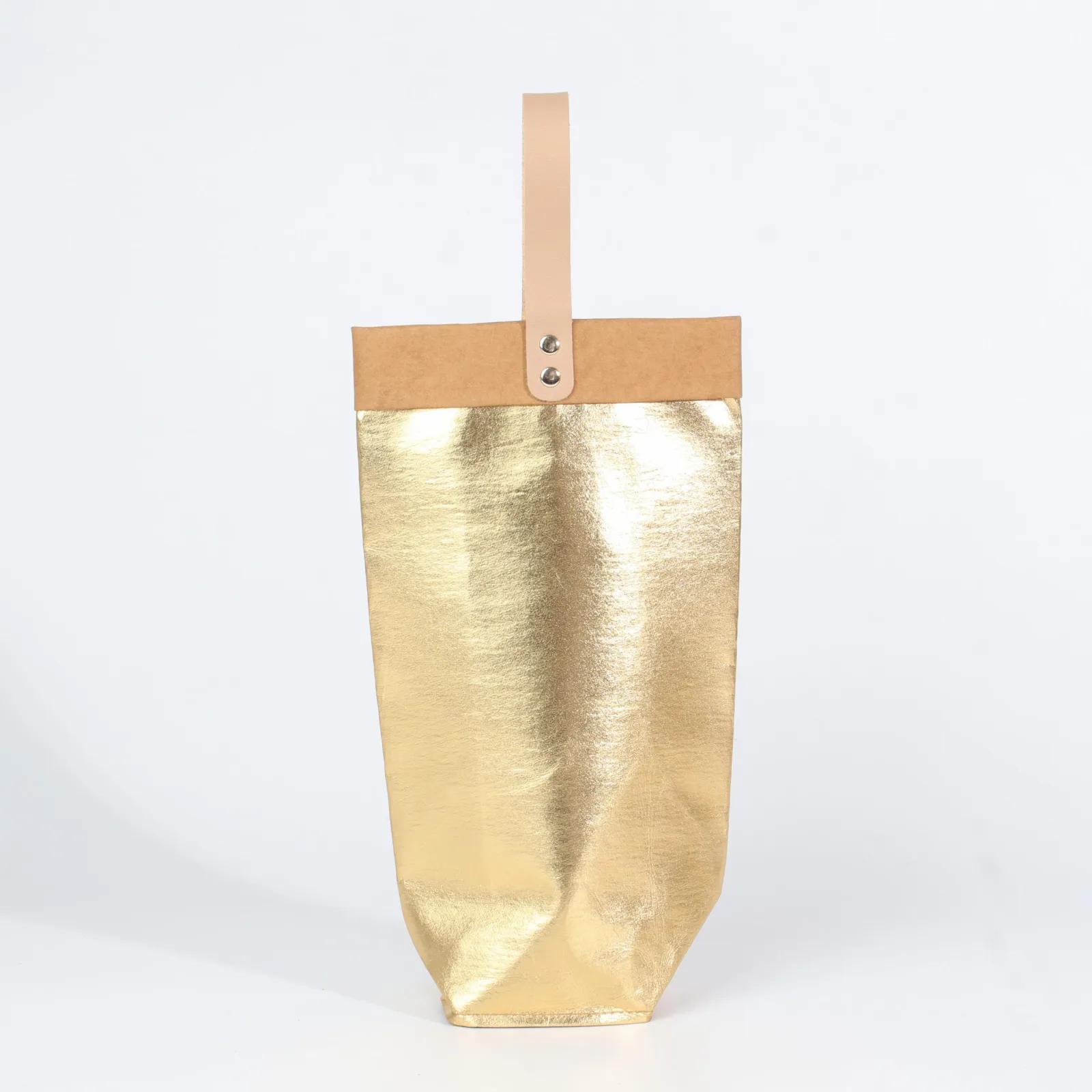
Kraft paper bags are the printable workhorse. Full-colour artwork, Pantone matching, and a low unit cost make them the default for wine shops and gift-with-purchase runs. The catch is the handle. A paper bag needs a reinforced handle patch, and that patch is where the bag fails first. If the patch is too small or the adhesive is weak, a heavy bottle pulls it loose. Look at our paper wine bags and you'll see the patch sizes we build around.
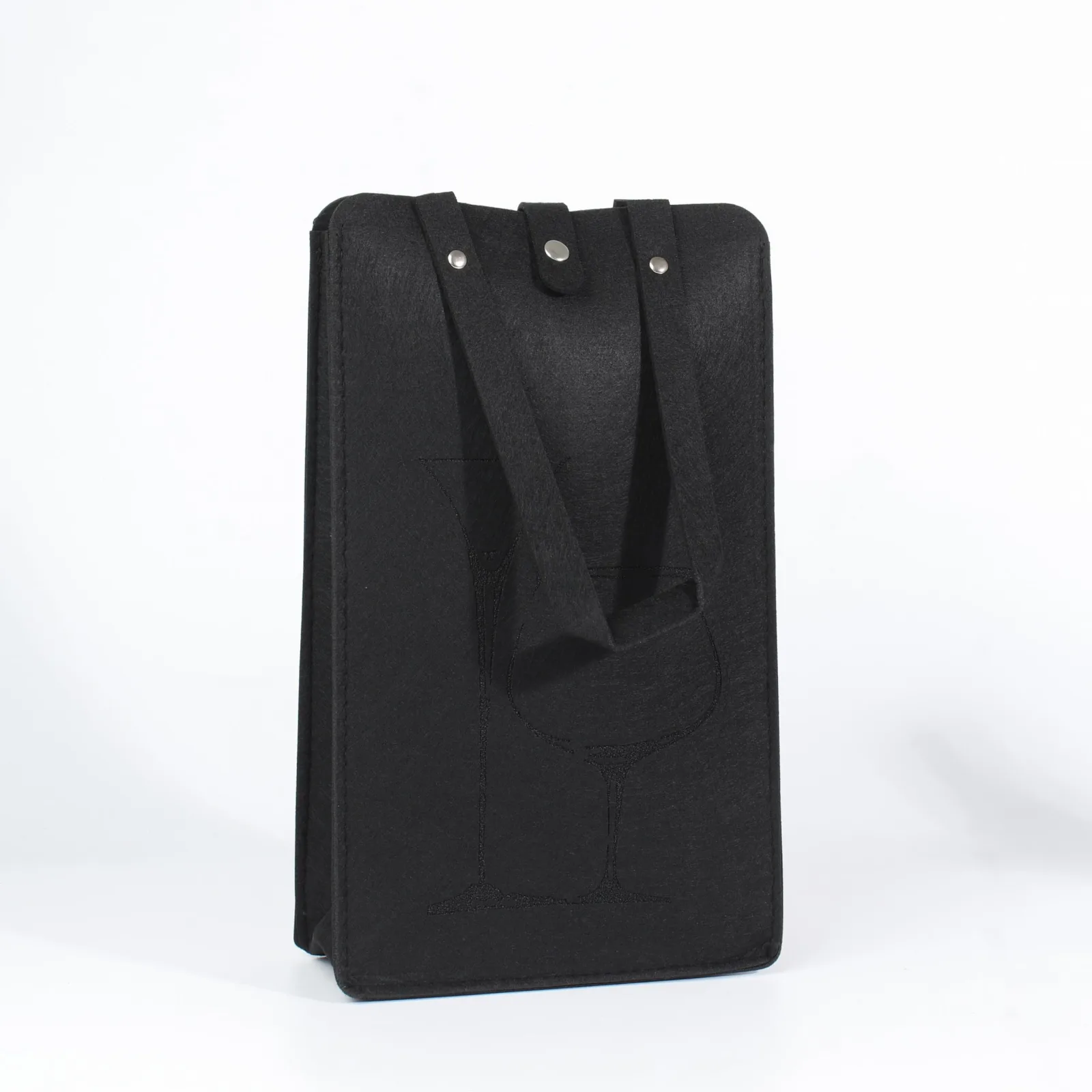
Felt and canvas are the middle tier and the one most buyers should look at first for reuse. Both are thicker, both hold shape, and both take stitched or riveted handles rather than glued ones. Felt has a soft hand and a dense look. Canvas has a visible weave and takes screen printing and embroidery well. Neither is waterproof, so if your buyer expects a bag to sit in a wet car boot, say so now. Our felt and canvas wine bags page shows the handle constructions we use.
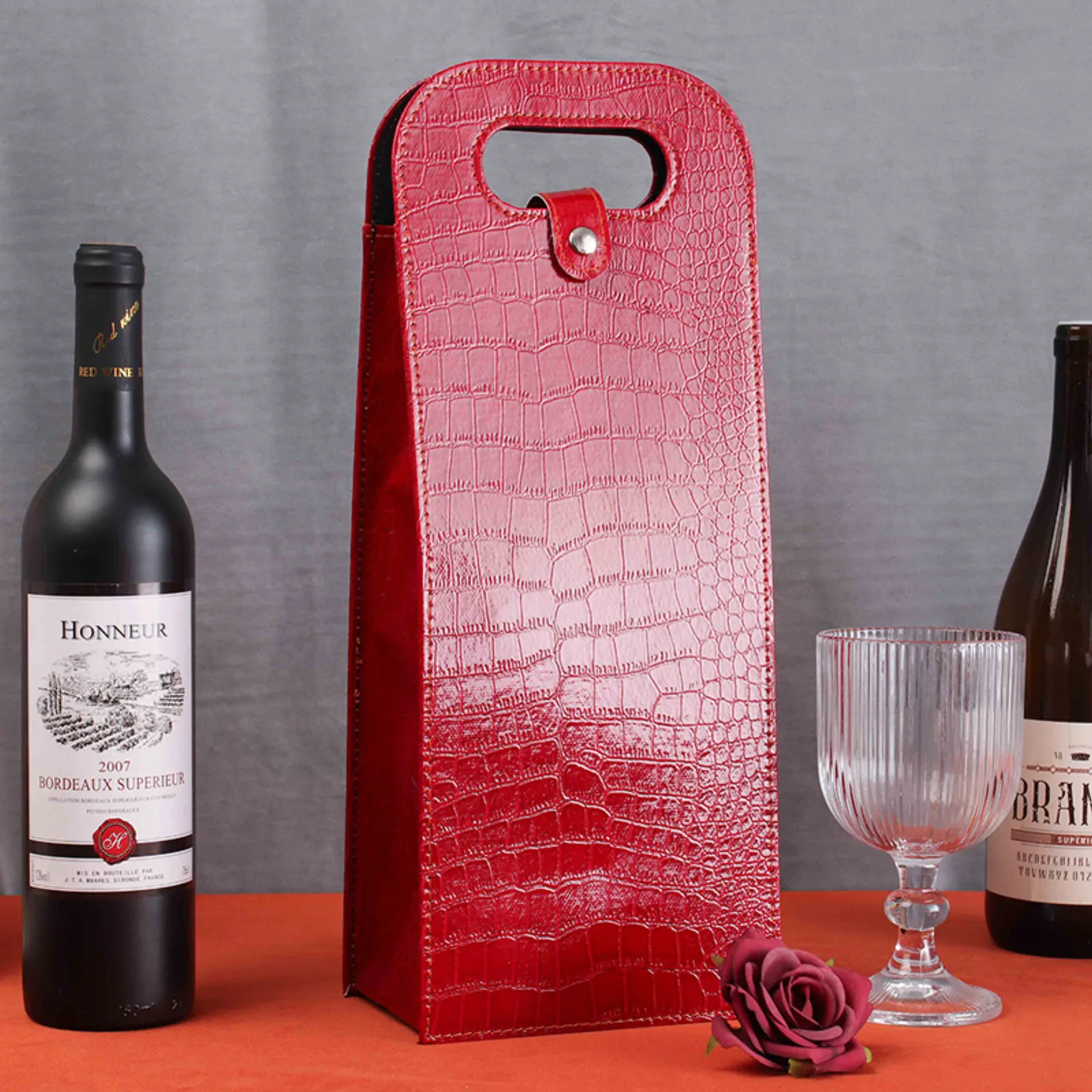
Leather and faux leather are the durable, premium end. Strong stitching and a secure closure matter more here than anywhere else, because a leather bag is expected to last. Stitch density, thread weight and the closure type all decide whether the bag feels expensive in the hand or cheap. A leather bag with a loose closure reads as a fake, even when the leather is real.
One thing to be clear about: insulated constructions are not part of our range. If your buyer needs thermal performance, a bag that keeps a white wine cold for a drive home, we are not the right source. Say that early and you save a sample round.
Handles and closures decide reuse
Every material has a different weak point at the handle. Paper needs a reinforced patch, sized to spread the load. Felt and canvas need stitched or riveted handles that go through the body, not just the top edge. Leather needs strong stitching and a closure that holds without being hard to open. Get this wrong and the bag fails on the second or third use, which is exactly when your buyer notices.
Closures are their own trade-off. Too tight and the customer fights it, or the bag tears at the seam. Too loose and the bottle moves, the bag sags, and the whole thing feels cheap. We test closures by loading the bottle and carrying it, not by looking at it. The same logic runs through our custom wine bag manufacturing process, where the handle and closure are decided before the artwork is finalised.
- A heavier bottle pulls hardest at the handle attachment, so patch size and stitch placement matter more than print.
- A stiff base board stops the bag sagging when the bottle stands upright.
- A closure that is too tight or too loose both fail in use, just at different moments.
- Insulated bags are outside our range, so thermal buyers should look elsewhere.
What we control, and how we check it
Our control tolerance for inserts is plus or minus 1 mm and for box bodies plus or minus 2 mm. That matters when a bag and a box ship as a set, because a bottle that fits the box must also sit correctly in the bag's base. For box-and-bag sets we check bottle fit with a shake, tilt and invert routine: shake for 10 seconds with no movement, tilt to 45 degrees with no slide, invert with no release. The bottle is held at four points, with no unsupported neck or shoulder.
Colour control follows the same discipline. We match to Pantone, approve a first article, then sample mid-run. Black, deep blue and burgundy are the hardest to hold, so if your artwork leans on one of those, expect to look at more than one sample. It's not a defect, it's the nature of those inks on textured stock.
For material and construction detail, our materials and structures page covers what we stock and what we won't use. No recycled greyboard, no high-moisture paper. Greyboard runs at 1200 g minimum, with 1400 g recommended for spirits. Facing paper runs at 157 g minimum.
The eight steps from brief to packed
Every job runs through the same eight production steps: online consultation, design confirmation, plate making and proofing, machine printing, machine lamination, machine box making, hand assembly, and quality inspection and packing. Hand assembly is where the handle and closure get fitted, and it's the step most buyers underestimate. It's also where a bad handle patch shows up before shipping.
Our in-house checks include a 1.2 m six-face drop test with the bottle loaded, a stacking top load of 40 kg or more held for 24 hours, and truck and sea vibration simulation with no internal movement. Those checks are ours, run on our bench, and they're how we catch a weak handle before it reaches your customer.
When we are the wrong answer
If your buyer needs a fully insulated bag, we are not the right source. If they need a material we don't carry, we're not the right source either. Saying that early is cheaper than a sample round that goes nowhere. The same goes for a bag that has to survive industrial reuse, hundreds of trips through a logistics loop. Our materials are built for retail, gifting and promotional use, not for that.
For everything else, the brief is simple. Send the bottle dimensions or a bottle sample, a reference design, the quantity, and any special requirements. We offer blank samples for structure and printed samples for visual approval, so you can check the handle and closure before you commit to artwork. If you want the material comparison in more depth, our kraft, felt and canvas comparison walks through it.
What to send us
Start with the bottle. Dimensions or a physical sample, plus a reference design, the quantity, and any special requirements. That's enough for us to recommend a material and a handle construction. If you already know the material, tell us and we'll confirm it's the right call for your reuse expectation.
We're an OEM and ODM manufacturer of wine bags and boxes, based in Yiwu, Zhejiang, founded 2014, with customers in over 30 countries. We design, develop structure, select material, print and finish. Payment is by T/T or PayPal, and shipping goes by air, sea or express. Reach us through the quote form or [email protected].
Trade-offs worth naming
A heavier bottle pulls at the handle attachment, so if your buyer's bottle is a heavy glass 750 ml, spec the handle before the artwork. A stiff base board stops sagging, but adds weight and cost, so decide whether the bag stands on a shelf or hangs on a rack. A closure that's too tight fails by tearing, one that's too loose fails by letting the bottle move. None of these are solved by colour.
The mistake we see most is a buyer choosing material by look, then discovering the reuse expectation doesn't match. A kraft bag for a one-time gift is smart. A kraft bag for a bag your buyer expects to see again next season is not. That one is not worth the money.
Key points
- Match the material to the number of trips the bag must survive, not to the photo.
- Paper needs a reinforced handle patch, felt and canvas need stitched or riveted handles, leather needs strong stitching and a secure closure.
- Insulated bags are outside our range, so thermal buyers should look elsewhere.
- Our control tolerance is plus or minus 1 mm for inserts and plus or minus 2 mm for box bodies.
- Send bottle dimensions, reference design, quantity and special requirements to start.
Questions buyers ask
What is the best material for custom reusable wine bags?
It depends on reuse cycles. Kraft paper is light and printable but creases and softens with handling. Felt and canvas are thicker and hold shape better over repeated use. Leather and faux leather are the most durable and premium. Match the material to how many times the bag will actually be carried.
Do you make insulated wine bags?
No. Insulated constructions are not part of our range. If your buyer needs thermal performance, we are not the right source and we will say so early. Our bags are built for retail, gifting and promotional use in kraft paper, felt, canvas and leather.
What do you need to quote a custom reusable wine bag?
Send the bottle dimensions or a bottle sample, a reference design, the quantity, and any special requirements. That is enough for us to recommend a material and handle construction. We offer blank samples for structure and printed samples for visual approval before artwork is finalised.
Send your bottle dimensions, reference design and quantity through the quote form and we'll recommend the material and handle construction that fits. Get a Quote
Put this on your bottle
Send the bottle sample or dimensions, quantity and a reference design. We reply with structure options and pricing.
- Email[email protected]