27 September 2026
Reusable Wine Bags Bulk: What to Specify on a Wholesale Order
Reusable wine bags bulk comes down to one question: does the substrate survive the second trip, not just the first fill? A bag that looks right in a photo and splits at the handle after three carries costs you a reorder. Here is how we think through material, print, handles and closures when a buyer is specifying at volume.
Start With How Many Trips
Reusable is a spectrum, not a yes or no. A kraft bag with a reinforced top edge and a proper handle might see a dozen trips in a gift context. A coated paper bag with a glued paper handle often sees one. Before you pick a substrate, decide what the bag has to survive: a single holiday gift, a promotional giveaway that gets carried around a trade show, or a retail bag a customer keeps in the car and refills.
That decision drives everything downstream. Paper is the cheapest path to a printed surface and the weakest at the handle. Felt holds its shape and cushions the bottle, so it takes knocks better. Leather and faux leather give the premium feel that a gifting buyer is usually paying for. If you want the material breakdown side by side, we wrote a fuller comparison in reusable wine bags kraft, felt and canvas compared.
Material Trade-Offs Across Our Ranges
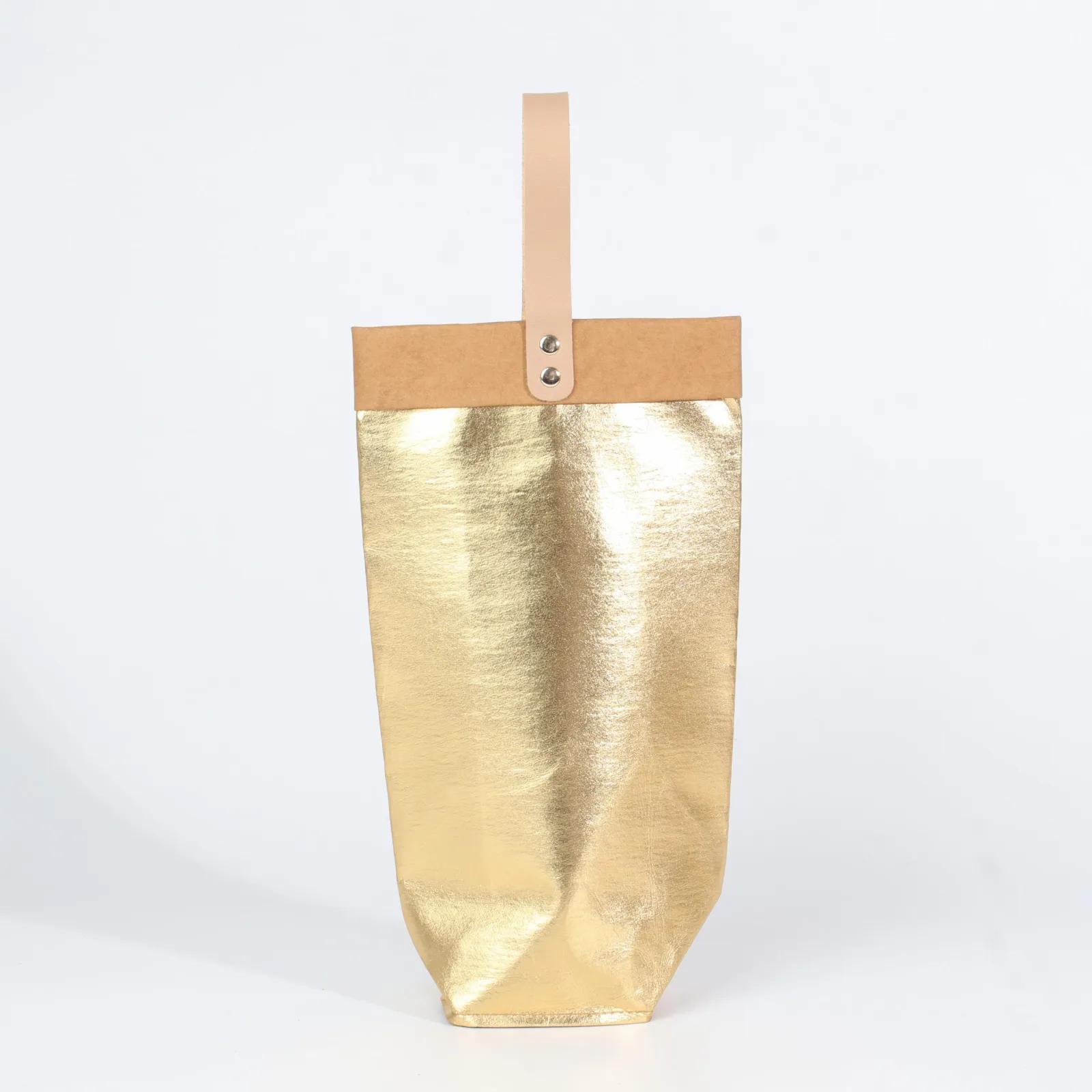
Kraft paper is where most bulk orders start. A washable kraft paper bag with a leather handle is the version worth specifying: the substrate takes repeated handling, and the leather handle does not delaminate the way a folded paper handle does. Coated paper prints beautifully and wipes clean, but the coating scuffs at the corners and the crease lines go white after a few folds. If your buyer wants the look of paper and the life of something tougher, washable kraft is the honest middle ground.
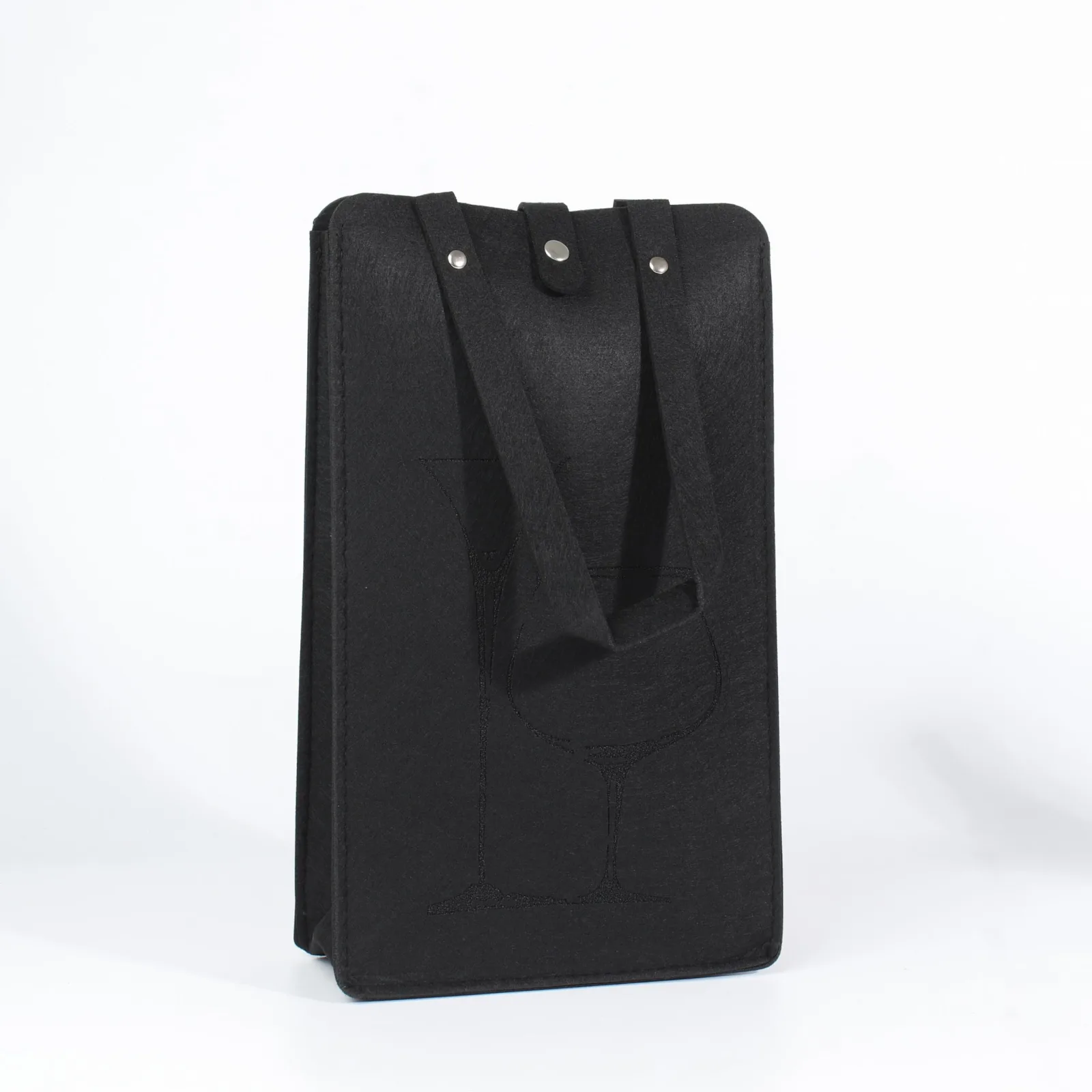
Felt and canvas behave differently. A felt bag with handles holds its shape when empty, which matters on a shelf, and it softens contact against the bottle. Canvas is the tougher of the two for abrasion; felt is the softer and the more gift-like. Both take embroidery well, which paper cannot do at all. See the construction options on our felt and canvas wine bags page.
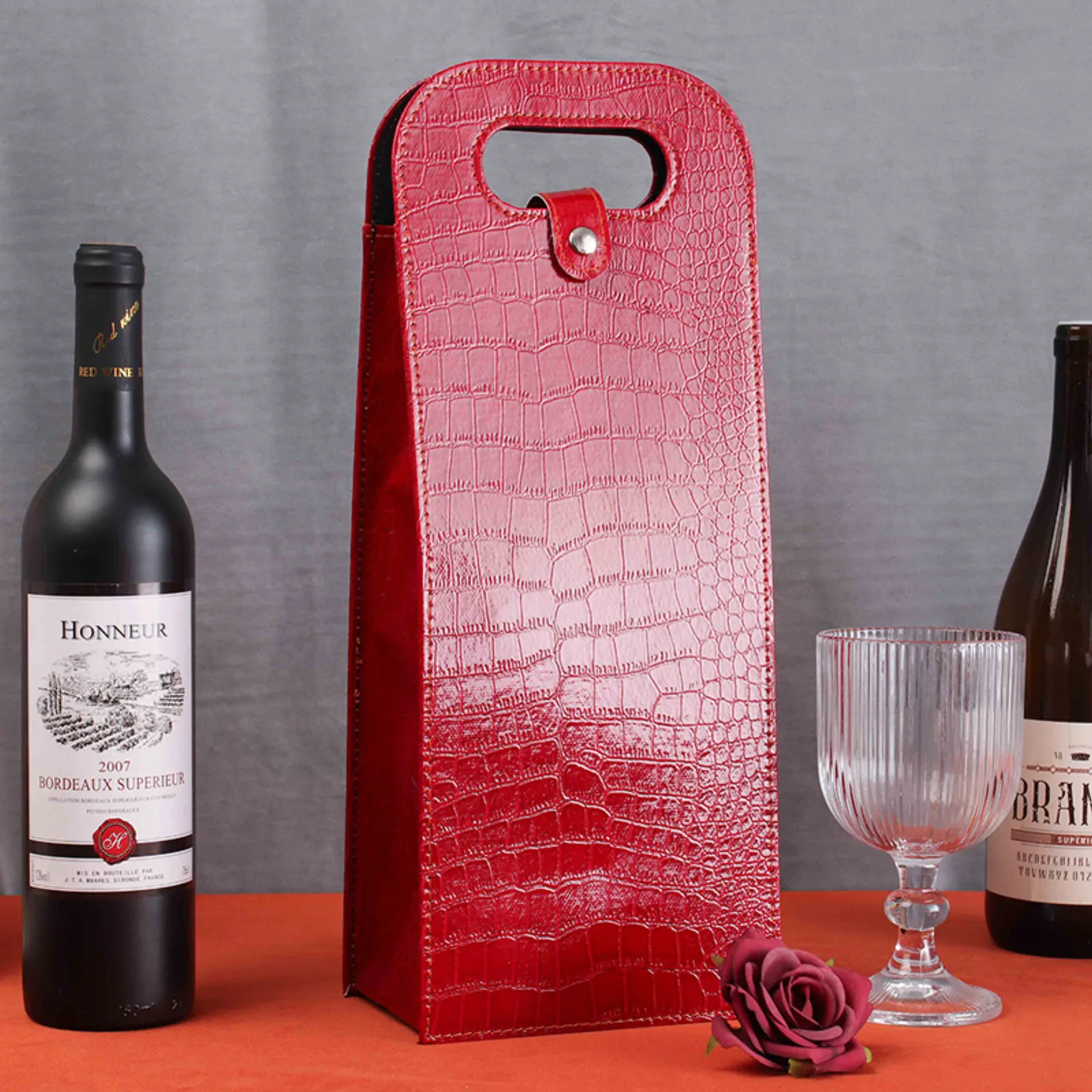
Leather and faux leather sit at the top. Real leather ages and takes a hot stamp cleanly. Faux leather gives you a consistent surface and a lower cost, but the finish can crack at a tight fold over time, so the pattern has to avoid sharp creases. For a promotional buyer running a premium giveaway, this is usually the tier that matches the brief.
Print Methods Depend on Substrate
You cannot choose a print method independently of the material. On paper and cardstock you have four-colour printing, foil stamping and UV printing. Four-colour gives you full artwork and gradients. Foil gives you a metallic hit that reads expensive, and it is the usual choice for a logo on a dark kraft bag. UV printing lays a raised, glossy layer on a matte surface, which is a quiet way to make a logo visible without a foil block.
Felt and canvas are a different set of tools: silk screen, hot stamping and embroidery. Silk screen handles flat one or two colour logos and holds up to wear. Hot stamping on felt gives a crisp metallic mark. Embroidery is the one that genuinely suits the material, because the stitch sits in the weave rather than on top of it. A stitched logo on felt looks intentional; a printed logo on felt often looks like it is floating.
Colour control is where paper orders go wrong. Black, deep blue and burgundy are the hardest colours to hold across a run. We control them with Pantone matching, first-article approval and mid-run sampling, and we say so up front because a buyer who needs an exact deep blue should know it takes attention. Our quality control process covers how that sampling works in practice.
Handles and Closures Fail First
If a reusable bag comes back to you, it is almost always the handle. The attachment point takes the entire load of a full bottle every time the bag is lifted. A handle glued to the outside of a paper bag will pull out. A handle that passes through the wall and is backed inside the bag survives far longer. On felt and canvas, the handle should be stitched through a reinforced panel, not just sewn to the top edge.
The top edge itself needs reinforcement. That is the second failure point: the rim folds and softens, then the handle tears through it. A turned and reinforced top edge spreads the load. On the base, stiffness matters more than thickness. A base that sags lets the bottle tilt, and a tilting bottle leans on the side wall, which then distorts. A rigid base board keeps the bottle upright and keeps the bag looking square on a shelf.
Closures are the last decision. A snap closure holds a folded top shut and is quick to open. A flap with a magnet gives a cleaner look and a more deliberate feel. Both are fine; what matters is that the closure lines up after the bag has been carried, which is a pattern question more than a hardware question. Magnet position is controlled to plus or minus 1 mm for exactly this reason.
Failure Modes We Flag Before Tooling
A gusset sized to a nominal volume rather than the real bottle is the most common spec error we see. A 750 ml bottle is not one shape. Burgundy, Bordeaux and Riesling bottles differ in shoulder height and body width, and a bag cut to an average will either fight the bottle going in or let it rattle. Send the actual bottle or its dimensions and the gusset gets cut to that bottle.
A handle that pulls out under a heavy bottle is the second. It usually traces back to a handle spec chosen for looks on a light bag. The third is a base that sags and tilts the bottle, which shows up as a bag that will not stand up on a counter. The fourth is creases that crack on foldable structures. Foldable boxes and bags that fold flat need creases that survive repeated folding; our control tolerance for foldable structures is that creases must not crack.
For inserts and box bodies we work to a control tolerance of plus or minus 1 mm on inserts and plus or minus 2 mm on box bodies. That is not a marketing number. It is the window that keeps a bottle from moving inside a box and keeps a lid sitting square. If your bag carries a box as a set, that tolerance is what stops the two parts from looking mismatched.
When We Are the Wrong Answer
We make wine bags and wine boxes. If your brief calls for insulated or cooler bags, neoprene sleeves, plastic, glass or metal tins, we do not make those, and we will tell you so rather than quote something we cannot build well. A promotional buyer who needs a cooler bag for a summer event should source that elsewhere.
The same goes for anyone who needs a bag to hold ice or keep a bottle cold for hours. Felt and canvas insulate a little; they are not cooler bags. If the requirement is thermal, this is the wrong category. Saying that early saves a sample round that was never going to pass.
Where we are the right answer is a printed, reusable bag or a box-and-bag set for retail, gifting or promotional use, in paper, felt, canvas or leather, with the structure and finishing done to your artwork. That is the whole of what we do, and doing it narrowly is why the details hold up.
What to Send Us
To quote a bulk reusable wine bag order, send four things. A bottle sample or the bottle dimensions, so the gusset and the base are cut to the real thing. A reference design or artwork, so we know the print method and the colour targets. The quantity, so the construction can be matched to the run. And any special requirements, such as a specific handle type, a closure, or a box-and-bag set that has to ship together.
From there we confirm the structure, then the print. You can see how that runs on our custom wine bag manufacturing page, and the fuller bulk buyer checklist lives in custom reusable wine bags for bulk buyers. Two sample types are available: a blank sample to prove the structure, and a printed sample to prove the visual. Most buyers want the blank first when the handle construction is new to them.
Key points
- Pick the substrate by trip count, not by how the bag photographs on a shelf.
- Handles and top edges fail first, so reinforce both before you worry about print.
- Cut the gusset to the actual bottle, not to a nominal 750 ml average.
- Black, deep blue and burgundy need Pantone matching plus first-article approval.
- If the brief needs thermal insulation, neoprene or tins, we are not the supplier.
Questions buyers ask
What does reusable mean for a bulk wine bag order?
It means the bag survives repeat carrying, not just the first fill. In practice that comes down to the handle attachment, the reinforcement at the top edge and the stiffness of the base. A coated paper bag with a glued handle usually fails at the handle within a few trips, while a washable kraft bag with a leather handle takes far more wear.
Which print method should I choose for felt or canvas bags?
Felt and canvas take silk screen, hot stamping or embroidery. Silk screen suits flat one or two colour logos and holds up to wear. Hot stamping gives a crisp metallic mark. Embroidery is the method that genuinely suits the material, because the stitch sits in the weave rather than on top of it, so a stitched logo reads as intentional.
How do you control colour on a bulk reusable wine bag run?
We match to Pantone, get first-article approval, then sample mid-run. Black, deep blue and burgundy are the hardest colours to hold across a run, so those get the most attention. If your brand colour is a deep blue, expect to approve a first article before the run proceeds, and expect mid-run sampling to confirm the match holds.
Send your bottle dimensions or sample, reference design, quantity and special requirements through the quote form and we will come back with a structure and a print plan. Get a Quote
Put this on your bottle
Send the bottle sample or dimensions, quantity and a reference design. We reply with structure options and pricing.
- Email[email protected]