04 October 2026
Fabric Wine Bags Bulk: What to Decide Before You Ask for a Quote
Fabric wine bags bulk runs begin with the cloth. Each bottle behaves differently when it's sat inside felt, canvas, or washable kraft paper. You'll pick cloth first, then work through handles, closures, printing, and packing, because cost and shelf survival come out of those later calls.
Felt, canvas or washable kraft paper
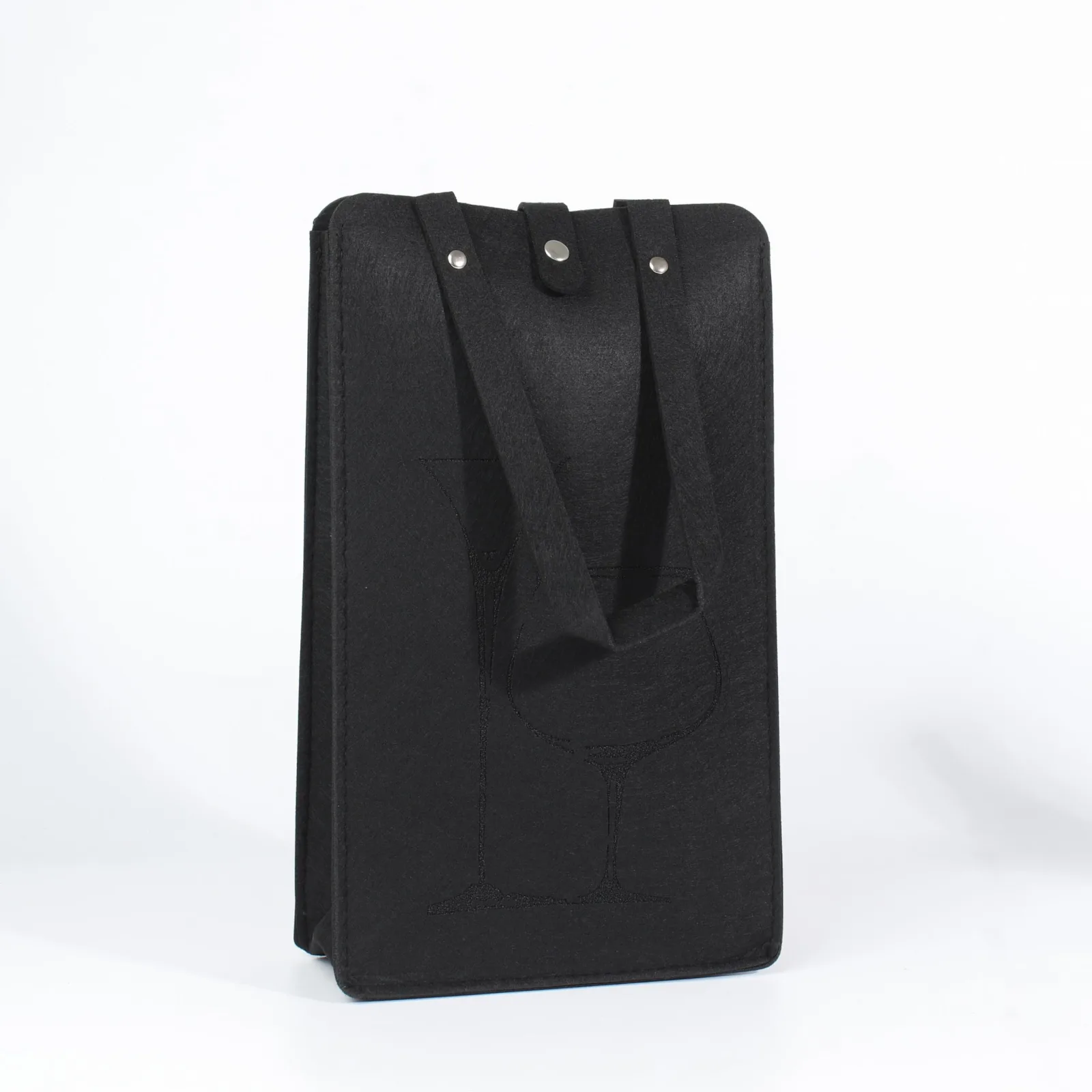
Felt takes a hot stamp cleanly since it's soft and thick, and it hides a bottle's shape well. On a shelf, one soft block is what you see, because seams in felt lie flatter than in most wovens. There's a catch: stretch. A felt bag cut close to a heavy spirits bottle can sag at the base, the cloth giving a little.
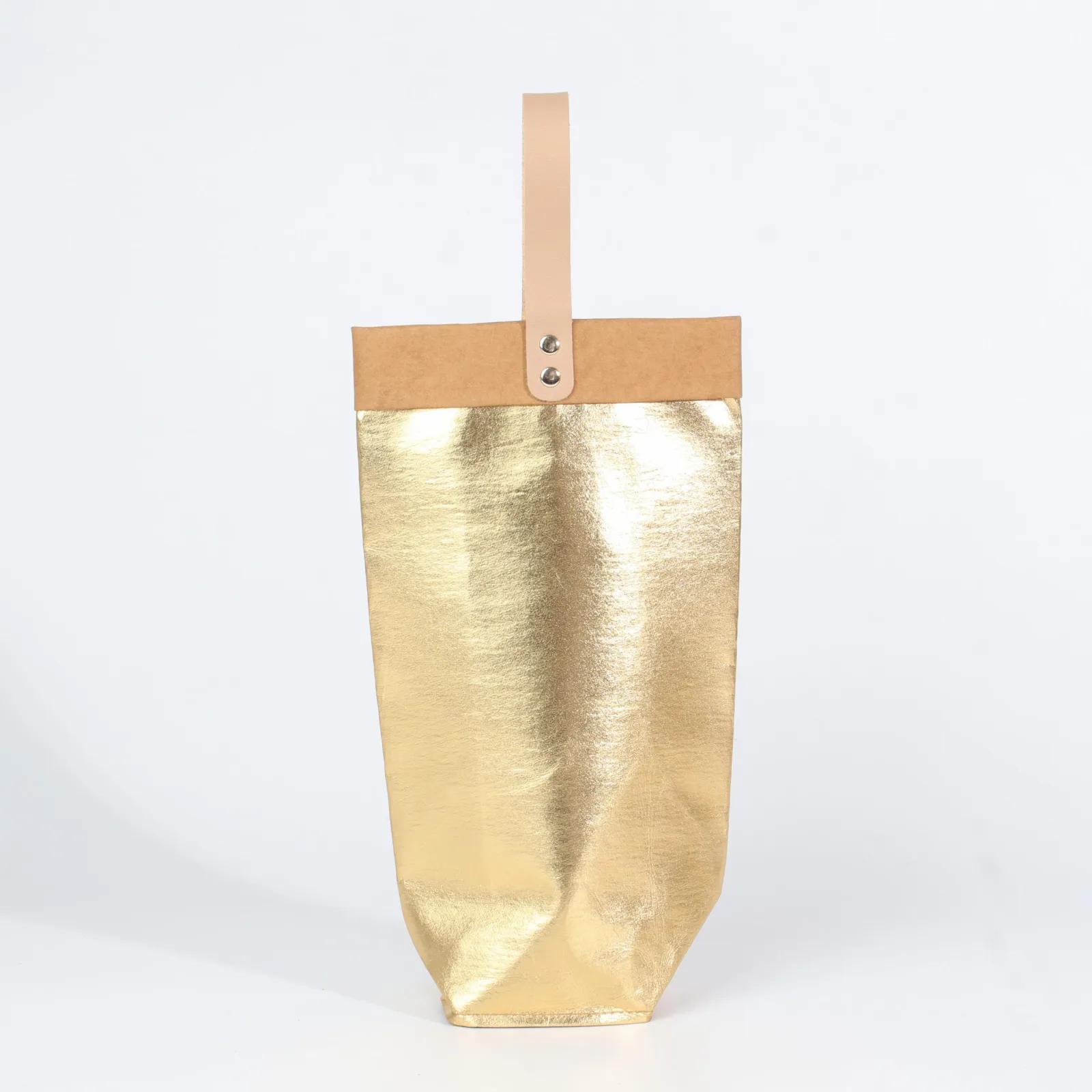
Canvas holds a 750 ml bottle with nearly no give, the strongest of the three for heavy spirits bottles, and silk screen, hot stamping, and embroidery all take well to it. If you want the bag that still looks structured after a few trips, canvas is usually your pick. Kraft paper you can wash is the lightest and most paper-like, crease-prone the way paper is, and a leather handle pairs well with it. That pairing is what most gifting buyers choose.
- Felt accepts hot stamping and masks the bottle's silhouette, but under load it stretches a little.
- Canvas is the strongest pick for heavier spirits bottles, and all three print methods work on it.
- Among the three, washable kraft paper is lightest and most paper-like, so you'd match it with a leather handle.
When fabric is the wrong answer
Fabric isn't always the answer. For a very light promotional run, a giveaway, with a single lighter bottle, paper costs less and does the job. Cardstock in our paper wine bag line suits lighter single bottles and reads print sharply on a flat sheet. For a gift set, though, look at box-and-bag sets: the bag is decoration, and the box carries the structure.
And there's the other wrong answer: a heavy bottle in a soft bag without a base board. Sets it down hard once, and the bottle drops through the bottom. Your bottle is heavy, so the bag needs a stiff base board. That call gets made at the start. Not after the sample.
- On very light promo runs, a paper bag does the job and costs less.
- With a box-and-bag set, the structure comes from the box and the decoration comes from the bag.
- A bottle lands heavy and nothing holds the base shape, so it drops straight through.
Handles, rivets and closures
Where the handle meets the bag, a heavy bottle pulls it out, which is the failure I see most. Rivet reinforcement at both ends of the handle fixes it, and stitch that handle through the bag wall instead of gluing it to the surface. Warm rooms kill glue.
A stiff base board matters just as much. Skip it and the handle pulls at an angle while the bag walls bow outward under the bottle. Include it, and the load sits flat, the handle staying vertical. A snap closure changes the bag too, holding the neck so the bottle can't lean. But it adds a step at assembly plus a metal part that has to sit in the right place.
Comparing fabric with other reusable formats? Kraft, felt, and canvas get walked through side by side in our guide to reusable wine bags compared by material.
- If the handles pull out at their ends, rivet reinforcement stops it.
- Send that fabric wine bags bulk run through first. Both a flat load and an upright handle call for a stiff base board.
- A snap closure grips the neck. But you pay for it with an extra assembly step and one more metal part.
Print, colour and what holds
Print methods for fabric wine bags bulk. Silk screen sits on top of the fabric, and you'll see it works best on canvas since the weave is tight. Felt works better with hot stamping, since that gives a metallic finish that lasts. Doesn't handle fine detail, so keep it bold. We also use embroidery, which adds texture and holds up. But each behaves differently, so you have to match the method to both the material and the art.
Colour control for fabric wine bags bulk. Buyers get surprised by colour because black, deep blue and burgundy are the hardest hues to hold on fabric and on board alike. Pantone matching, first-article approval and mid-run sampling are our controls. You approve the first piece before the run continues. Then during the run, we pull samples to check the colour hasn't drifted. Not a promise, just a process.
Control tolerances. Box bodies come in at plus or minus 2 mm, inserts at plus or minus 1 mm, figures from our own checks rather than any standard. When your artwork has tight registration, tell us early so we can plan the print method around it.
- Silk screen print comes out best on tight canvas weaves. Felt? That one takes hot stamping well.
- Embroidery lasts, yet fine detail gets lost, so keep the artwork bold.
- Black, deep blue and burgundy. Those three are the harder ones to hold.
- First-article approval, Pantone matching and mid-run sampling are our controls.
What we need to quote
What we need. Dimensions for the box or the bag, or a bottle sample. A bottle sample is better because then we can measure the shoulder and the base ourselves. Send a reference design too, even a photo of something you liked, and that tells us the look you're after. Then quantity and any special requirements, like a snap closure, a leather handle or embroidery.
Sample types for fabric wine bags bulk. You have a blank sample to check structure and a printed sample to check the visual. Most buyers start with the blank, since structure problems are cheaper to fix before print. Our custom wine bag manufacturing page shows how this runs if you want to compare options. Materials and structures sit on our materials page.
- You can't get a quote till we've seen the bottle's dimensions or a physical sample, plus a reference design, your unit count and anything out of the ordinary.
- Structure gets checked while it's still blank. Print's where the visuals get checked.
- Harness the power of fixing structure before print. Seek unique synergy.
Checks before the bags ship
In-house checks for fabric wine bags bulk. With the bottle in the bag, we run a loaded drop test at 1.2 m across six faces. There's a stacking top load of 40 kg or more for 24 hours, and a truck and sea vibration simulation too. All confirm no internal movement. Before the bags leave, those checks catch the handle pull-out and the base board failure.
Quality control and tolerances. In production, our control tolerance is plus or minus 1 mm on inserts and plus or minus 2 mm on box bodies, while for foldable boxes it covers three things: creases must not crack, magnet position is plus or minus 1 mm, and corners stand at 90 degrees when erected. Four points hold a bottle in a box, with no unsupported neck or shoulder. Read more on our quality control page.
Insert rule for fabric wine bags bulk. Shake for 10 seconds with no movement expected, tilt to 45 degrees without the bottle sliding, and invert without it releasing. That's the insert rule. A bag that fails isn't ready.
- One point two metres, six faces, bottle still inside the fabric sack.
- Check out the cool stacking force and wait for it, bottle stays safe for 24 hours.
- Vibration simulation teaches you what shifts.
- Shake for 10 secs, tilt to 45° and flip, nice to see you.
Specification checklist
Fabric wine bags bulk. Price talks start only after you've nailed the cloth, the handle, the closure, the print method, the colour standard and the carton style. Pick from felt, canvas or washable kraft paper. Handle options are rivet reinforced, stitched through the wall, or leather; closure is open top or snap. Black, deep blue and burgundy need more care, and colour runs on a Pantone reference. Your print calls are silk screen, hot stamping or embroidery.
Shipping style matters. Flat or erected? Does a bottle sit inside? A bag that travels flat has to keep its crease intact on the road.
Soon the bottle itself gets sorted. You'll usually face a 750 ml one, and the shoulder shape swings the whole answer. Send that bottle, or its measurements, so we can name the cloth and handle that hold it. If a box-and-bag set is the better result, we'll say so.
- Fabric, handle, closure, print, colour, packing. Note them down before you ask, the fabric wine bags bulk example.
- Once your bags are shipped flat, a crease that won’t survive makes cracks appear. That fold line? Has to hold under stress.
- Because shoulder shape decides which bag fits, send us the bottle itself (or just its measurements). Pick the right fit.
Key points
- Your fabric choice settles one question, and it's simple: with a full bottle inside, does the stuff stretch when lifted?
- As a means of guarding against the two typical breakdowns (fabric failure and handle failure), a board stiffens the bottom while a rivet on the handle gets reinforced.
- Among the colours, three of them prove the trickiest to keep consistent, and they are as follows: black, then deep blue, then burgundy.
- A bottle sample, any reference design, your unit counts, and anything odd about the order. That’s a genuinely useful package for you to send over.
- We check two things ourselves: a vibration simulation, plus a drop test with the bag loaded up.
Questions buyers ask
What fabric is best for bulk fabric wine bags?
Canvas accepts silk screen, hot stamping, and embroidery, and since it's the sturdiest wearer, it suits heavier spirits bottles best; felt, thick and soft as it is, hides the bottle's shape well, while kraft paper that washes is the lightest option and feels most like paper, and unlike the structural frames, it gets paired with a leather handle, so when you're weighing choice of fabric, account for bottle weight first.
How do you stop a handle pulling out of a fabric wine bag?
<strong>Fabric wine bags bulk.</strong> A rivet where the handle meets the bag, with the handle passing through the bag wall instead of being glued on. Why? Because glue fails in a warm room.
What do I need to send for a fabric wine bag quote?
To match the fabric and handle, send bag dimensions or a bottle sample, plus a reference design, the quantity, and extras such as a snap closure, a leather handle or embroidery. If you measure the shoulder and base yourself from an actual bottle, that's better than relying on numbers alone.
Once you send the bottle dimensions, reference design, quantity and special requirements, you'll get back the fabric and handle suited to carrying it. Get a Quote
Put this on your bottle
Send the bottle sample or dimensions, quantity and a reference design. We reply with structure options and pricing.
- Email[email protected]